







Welcome!
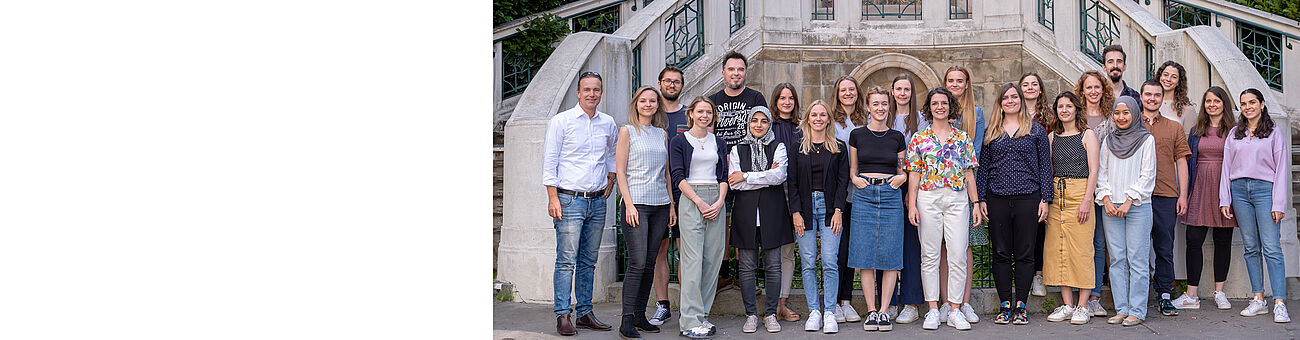
As a part of the Department of Communication of the University of Vienna, the Vienna Advertising and Media Psychology (AdMe) Research Group deals with the impact of modern media environments on people's thinking, behavior, and opinions. The research focus of our group includes areas such as marketing communication, advertising effectiveness, hybrid forms of advertising, political advertising, as well as the cognitive, emotional, and behavioral effects of mass media more generally. Working with quantitative and qualitative social science methods, we integrate scholarship from communication science, social psychology, political science, and marketing.
NEWS
- October 13, 2026
Award win! Jaroslava Kaňková and Rinat Meerson were recently honored with the Klaus Schönbach Research Award of the Department of Communication. The award aims to support PhD students and postdocs to pursue, hone, and enhance their own international line of research. Jara and Rinat received the award for their proposed project entitled Too rushed and flattered to notice? Developing and testing a critical AI literacy intervention countering the persuasive and epistemic risks of sycophantic AI, which they will pursue during the upcoming months.
- October 12, 2026
ICORIA 2027 – Call for Papers! Our team will co-organize the ICORIA 2027 Conference entitled The Future of Advertising, scheduled from July 15-17, 2027, in Vienna.
The Call for Papers can now be accessed here. The deadline for the submission of papers is March 1, 2027.
- October 8, 2026
More papers accessible! Information, Communication & Society just released our new research paper entitled Whose voices and which effects? A scoping review of migration and social media effects (doi:10.1080/1369118X.2026.2733513). In this scoping review, authors Aleksandra Lazić, Maryam Khaleghipour, and Jörg Matthes map social media effects in the context of migration, revealing a striking divide in the research landscape between host- and migrant-centered studies. The review calls for more integrative research that brings both perspectives together.
- October 7, 2026
Article available! The paper AI on dating apps: Links between usage frequency, self-efficacy, self-esteem, and willingness to use AI (doi:10.1016/j.tele.2026.102460) by Alice Binder, Anja Stevic, Jaroslava Kaňková, and Jörg Matthes appeared in volume 110 of Telematics and Informatics.
- September 29, 2026
New paper published! Helena Knupfer's, Phelia Weiß', and Jörg Matthes's collaboration entitled Mobilizing potential? Right-wing terrorism-related social media use, fear, and civic engagement among German Muslims (doi:10.1080/15205436.2026.2731919) was released by Mass Communication and Society last week.
- September 18, 2026
Paper alert! Computers in Human Behavior has just released yet another publication by our team, a collaboration between Simone Moser, Stephanie Bührer, Diana Kostikova, and Jörg Matthes titled From hostile feedback to withdrawal: Emotional exhaustion as a barrier to social media misinformation correction (doi:10.1016/j.chb.2026.109179). The paper is available online and will appear in-print in volume 187 of CIHB in 2027.
- September 14, 2026
Post-summer publications update! A total of six new papers were released over the course of the last few weeks. You can find all references in alphabetical order below.
Hirsch, M., Bührer, S., Koban, K., & Matthes, J. (2027). Approval mechanisms fueling digital hate: Online incivility and intolerance perpetration in four countries. Computers in Human Behavior, 186, 109143. https://doi.org/10.1016/j.chb.2026.109143
Khaleghipour, M., Koban, K., & Matthes, J. (2026). The strategic provocation of digital hate: Empowered targets' perceptions of perpetrators and bystanders. Information, Communication & Society. Advance online publication. https://doi.org/10.1080/1369118X.2026.2674873
Meerson, R., Koban, K., & Matthes, J. (2027). Pretty privilege? Effects of perpetrators' attractiveness and hate type on user responses against misogynist digital hate. Computers in Human Behavior, 186, 109112. https://doi.org/10.1016/j.chb.2026.109112
Nguyen, G., Bührer, S., Koban, K., & Matthes, J. (2026). Where digital hate finds its home: Perpetrators' preferred affordances and their experiences with content moderation and user intervention. Information, Communication, & Society. Advance online publication. https://doi.org/10.1080/1369118X.2026.2663190
Thomas, M. F., Binder, A., & Matthes, J. (2026). Decision-making on dating apps: Is swiping more less and swiping right wrong? Media Psychology, 29(5), 867-898. https://doi.org/10.1080/15213269.2025.2555430
Thomas, M. F., Binder, A., & Matthes, J. (2026). Safer sexting: Who cares and how? Cyberpsychology: Journal of Psychosocial Research on Cyberspace, 20(4), Article 7. https://doi.org/10.5817/CP2026-4-7